
Carroll County Bench Warrants Explained
A bench warrant is court process tied to an existing case or order. In Carroll County, a missed initial appearance, trial setting, or other required appearance may lead to an FTA-related action. The county docket sample uses “Warrant Bench,” while the General Sessions rules use the term “capias.”
Those labels are related but not always interchangeable. The exact order and issuing court matter. A probation-violation warrant is also a separate post-conviction process, so a person should ask which event appears in the file instead of assuming it is a new charge.
Carroll County Warrant Bench Labels
The county's public docket example includes “Warrant Bench” as a case/type label and “Failure to Appear” as a violation description. A label can help locate the right file, but it does not say whether the court later recalled the order or whether law enforcement served it.
When speaking with the criminal clerk, ask whether the record shows a capias, bench warrant, summons, show-cause order, or another action. Ask what court set the underlying case and whether a later docket entry changed the process.
The county's sample docket is useful for field names only. It contains private case data and should not be copied into a public roster.
The Tennessee AOC clerk directory identifies the court clerk routes for the county and its cities.
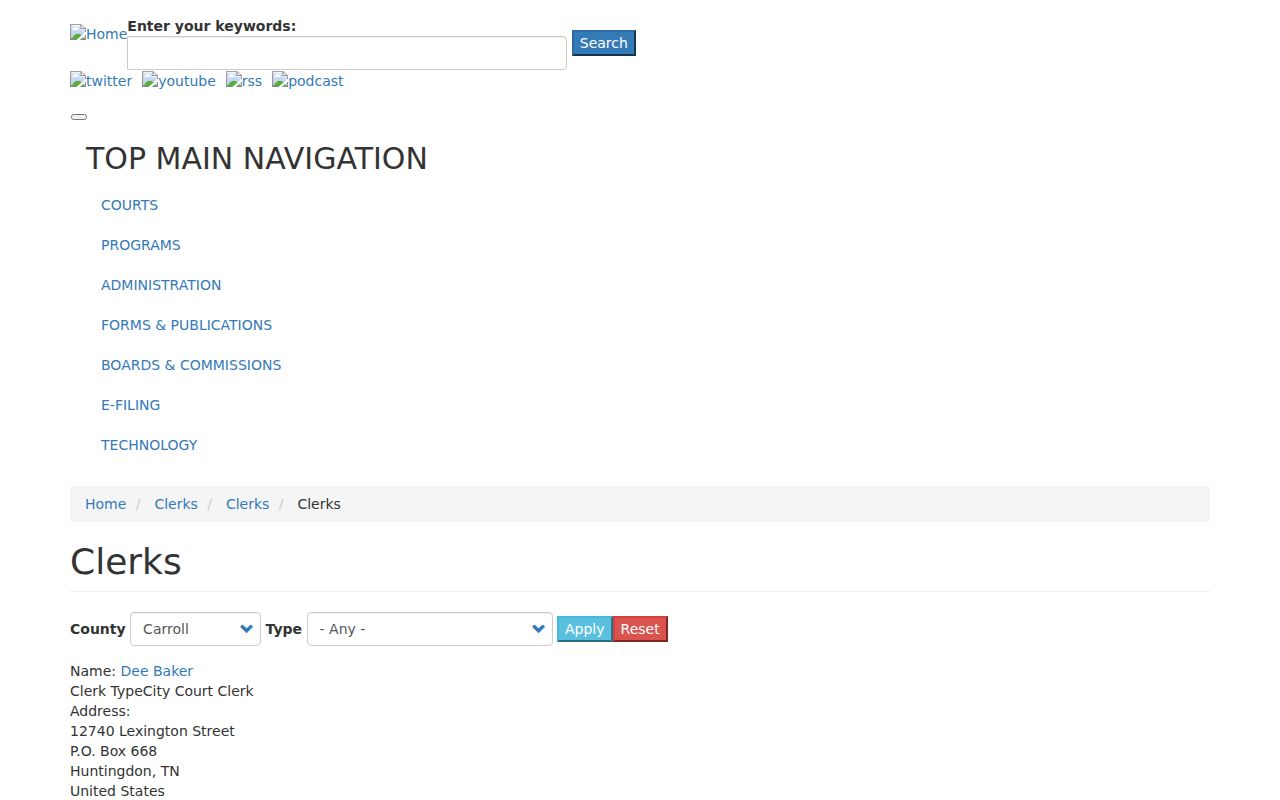
The clerk directory helps identify the office; it does not confirm a warrant's current status.
How Carroll County Bench Warrants Are Issued
A judge decides whether a missed obligation requires additional process. The file may then show a capias or bench-warrant event, and law enforcement may receive a service instruction. The county's public court search can help find case history, but it does not publish an operational service record.
There is no public statewide Tennessee warrant search identified in the research. Restricted law-enforcement systems are not available to the public. A clerk can explain the docket path; only the issuing court can say whether the order remains in force.
Carroll County Bench Warrant Wednesday Dockets
General Sessions criminal sessions are generally Wednesday. Traffic citations begin at 8:30 a.m.; trial dockets are at 9 a.m. and 1 p.m. A sheriff-delivered warrant received by Tuesday at 10 a.m. is prepared for the Wednesday initial-appearance cycle, subject to a late-arrest exception.
Initial-appearance and bond hearings are scheduled as needed, so a docket time does not show whether a person must appear. Check the clerk's current calendar and the Tennessee criminal rules with Carroll's local procedures.
Bench Warrants and Arrest Warrants Compared
A bench warrant follows a court obligation in an existing matter; an arrest warrant follows a criminal complaint and judicial review of probable cause. Both may lead to custody, but their triggering events and court records differ. A bench-warrant question should start with the court that scheduled the missed appearance.
| Feature | Bench Warrant | Arrest Warrant |
|---|---|---|
| Trigger | Missed appearance or court-directed obligation | Complaint and probable-cause review |
| File context | Existing case or order | Criminal complaint or new charge |
| Authority | Issuing judge or court | Judge issues a warrant or summons under Rule 4 |
| Next step | Ask the court about appearance, recall, or quash | Ask counsel and the issuing court about service and appearance |
Carroll County Bench Warrant Bond Records
Carroll County local rules discuss appearance bonds, but the official sources reviewed did not publish a current countywide bond schedule, universal payment method, or release-time promise. The court-fee vendor linked by the county is a payment route for directed fines or citations, not proof that a capias has been recalled.
Ask the clerk whether a bond has been set in the specific case and ask the sheriff or jail about booking and release logistics. A records-request fee, citation payment, bond, and state reinstatement fee are different obligations.
Resolving a Carroll County Bench Warrant
Start by identifying the issuing court and asking what action it requires. A lawyer can advise whether to request a reset, file a motion to recall or quash, arrange a voluntary appearance, or address the underlying obligation. The clerk can explain filing and calendar steps but cannot give legal advice.
- Find the case reference and confirm which court issued the process.
- Ask counsel whether a motion, waiver, reset, or appearance is appropriate.
- Call the clerk before attending to learn the current date and filing rules.
- Ask the sheriff or jail about surrender, booking, and bond logistics.
- Keep the court's written order or receipt after the next step is complete.
Caution: Do not assume a fine payment or a blank online result recalls a capias; obtain the issuing court's confirmation of the next step.
County case history is searchable through TNCRT, but the search has no warrant-status field and does not show a sheriff service log. A clerk can explain the latest docket entry, while the Sheriff's Office can answer a separate question about enforcement logistics. Ask each office about the same case number so the answer stays tied to the correct court file.
Carroll County Bench Warrant Filing Deadlines
Local rules allow an attorney-represented defendant to waive an initial appearance using the required waiver and notice of appearance. The filing deadline is 10 a.m. Tuesday before the session. A faulty or late filing can result in a capias, so a lawyer should check the current form and clerk instructions.
The county Circuit Court page links local forms, including the waiver and indigency materials. Do not treat a form download as court approval; the judge and clerk determine whether a filing meets the rules.
People without counsel should ask the clerk how to identify the correct hearing and what public information is available, then seek legal advice where possible.
The waiver option described by the local rule applies to an attorney-represented defendant and requires the prescribed notice and filing timing. It is not a general self-service form that cancels a capias on submission. Before relying on it, counsel should confirm the current version with the Circuit Court office and determine whether the judge accepted the filing in the specific case.
Carroll County forms and clerk informationCarroll County Capias Service and Court Entry
A capias entry, a return showing service, and a later recall order are separate events. TNCRT can help locate the county case history, but it does not show a live sheriff service log or a warrant-status toggle. Ask the issuing clerk to read the most recent docket action and confirm whether the court expects another appearance.
General Sessions local rules describe a Wednesday initial-appearance cycle for qualifying warrants received by the sheriff by 10 a.m. Tuesday, with an exception for later arrests. That scheduling rule does not promise a particular hearing time or release result. For enforcement logistics, the Sheriff is listed at 731-986-8947 and the jail at 731-986-1906.
Finding the Court That Issued the Warrant
For Carroll County, Circuit/Criminal Court and General Sessions records route through the Circuit Court Clerk and the criminal clerk staff at 99 Court Square. The Clerk & Master handles Chancery records, not routine criminal warrant status. A municipal court clerk holds city traffic or ordinance records, with current arrangements to verify in Atwood and Trezevant.
The Carroll County public case portal can help identify a court file. Call the clerk listed on the county court contact page with the case reference. The sheriff serves process and can discuss enforcement logistics; only the issuing court controls recall.
The county office lists general courthouse hours of 8 a.m. to 4 p.m., but a public counter's hours are not the same as a judge's docket. Confirm the division and current schedule before visiting. Chancery matters go through the Clerk & Master; criminal and General Sessions warrant questions should be directed to the matching criminal clerk.
Carroll County City Warrants Need Clerks
Huntingdon, McKenzie, Bruceton, and Trezevant publish different city contact routes, while Atwood's current municipal-court status is unclear in official directories. A city citation should first be matched to its town court or recorder, not sent to the county clerk by default.
The Tennessee AOC clerk directory lists county and city clerk entries. Confirm the office and address before an in-person visit because directory formats and city arrangements can change.